SHAKUHACHI
SHEET MUSIC Original
Compositions for Shakuhachi
•
Solo, Duet, Quartet, Quintet & Orchestra
• Ensemble with Japanese Koto & Shamisen
• Ensemble with Western Stringed Instruments
Scores
in Kinko-ryu & Western 5-Line Staff Notation Each
score accompanied by a CD
FLARE UP
For solo Shakuhachi
Flare Up is a challenging
solo shakuhachi piece that uses double-tonguing, singing while playing
and some extremely high notes. Based on a repetitive
rhythmic pattern, the music builds from beginning to the end in one long
crescendo culminating in a fortissimo climax.
Western
5-Line Staff notation.
6 minutes, 4 pages.
Can also be played
on Western silver flute.
JS-2 - Comes with a CD recording of the piece performed by
James Nyoraku Schlefer.
BROOKLYN SANYA For solo Shakuhachi
Brooklyn
Sanya is based on the honkyoku “Sanya.” It maintains
the spirit, formal structure, and many of the melodic elements of
the traditional
music, while incorporating new musical ideas.
Western 5-Line Staff and Kinko-ryu notation.
9 minutes, 7
pages.
Can also be played
on Western silver flute.
JS-3 - Comes with a CD recording
of the piece performed by
James Nyoraku Schlefer.
AZUMA
NO KYOKU Duet
for two Shakuhachi
The original melody of Azuma
no Kyoku is accompanied by a newly composed melody that provides
a harmonic second part. The second part can be played
on a 2.0'
or a 2.4' shakuhachi, or the piece can be played with 1.6' and 1.8' shakuhachi.
Western
5-Line Staff and Kinko-ryu notation.
8 Minutes, 8
pages.
Can also be played
on Western silver flute.
JS-4 - Comes with
a CD recording of the piece (MIDI FILE).
COUPLE
DANCE Duet
for two Shakuhachi
Couple Dance is an original score
that was composed for modern dance. The work presents several rhythmic
sections alternating with slower sections,
and a unique
percussion section. Second part doubles on 2.4'.
Western
5-Line Staff notation.
15 minutes, 15 pages.
Can also be played
on Western silver flute.
JS-5 - Comes with a CD recording made by John Kaizan Neptune and James Nyoraku
Schlefer.
TIMELESS
MOMENT Quartet for four Shakuhachi
Original
music for four shakuhachi with the fourth part doubling on 2.4'. This
is a simple, gentle piece.
Western
5-Line Staff and Kinko-ryu notation.
4 minutes, 6 pages.
JS-6 - Comes with
a CD recordingof the piece (MIDI FILE).
KUMOIJISHI Quartet for four shakuhachi
The original melody of Kumoijishi is accompanied by
three shakuhachi grouped as a chordal accompaniment. This version of
the honkyoku classic is a true blending of musical cultures. Three
1.8 and one 2.0' shakuhachi.
Western 5-Line Staff
and Kinko-ryu notation.
7 minutes, 9 pages.
JS-7 - Comes with
a CD recordingof the piece (MIDI FILE).
DUO NO.
1 Duet
for Shakuhachi & Koto
This duo is a fast-paced,
highly rhythmic piece with a meditative slow section and a section based
on the Blues.
Western
5-Line Staff notation.
12 minutes,
10 pages legal size.
Can also be played
on Western silver flute.
JS-8 - Comes
with a CD recording of the piece performed by James Nyraku Schlefer (shakuhachi)
& Masayo Ishigure (koto).
DUO NO.
2 Duet
for Shakuhachi & Shamisen
Rapid-fire shamisen
licks, and double-tongued shakuhachi form the basis for this fast moving
work that has a beautiful slow section
using Japanese scales.
Western
5-Line Staff notation.
8 minutes, 11 pages.
Can also be played
as a Flute and Guitar duo.
JS-9 - Comes with a CD recording of the piece performed by James Nyraku Schlefer
(shakuhachi)
& Yoko Reikano Kimura (shamisen).
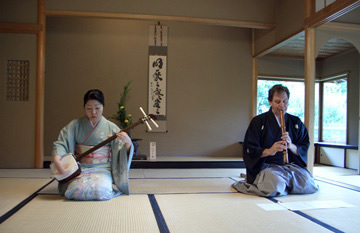
Recorded live in Japan, this is a performance of "Duo No.2" is performed by James Nyoraku Schlefer and Reikano Kimura.
DARANI For
Shakuhachi, Violin, Viola & Cello
Darani is originally a honkyoku piece for solo shakuhachi.
This arrangement presents the original, beautiful melody in a new,
harmonic setting
accompanied by Western
string trio.
Western
5-Line Staff notation.
8 minutes, 8 page score, includes separate
parts for each instrument.
Can also be played
on Western silver flute.
JS-10 - Comes with
a CD recordingof the piece (MIDI FILE).
QUINTET For
Shakuhachi, Two Violins, Viola & Cello
Quintet was written with three of my favorite elements
of music at the forefront; rhythm, structure, and the combined sound
of a sting quartet
with shakuhachi. The three-movement form recalls a Baroque-era concerto
grosso, with its fast-slow-fast structure, but within a distinctly contemporary
musical idiom. Both the first and last movements have substantial solos
for both the violins and the shakuhachi. The first movement is in two
sections. The first part revolves around a disturbing melody that recurs
several times. This gives way, first to an energetic call and response
between the shakuhachi and first violin, and then to a lighter pizzicato
section that resolves the unease of the main melody but leaves the listener
with a question mark. The second movement starts as a blues and devolves
into a section of true despair. The shakuhachi solos are in the style
of the traditional music of Zen meditation. The third movement is in
rondo form and presents a jagged main theme that recurs throughout and
is punctuated by several rock-style solo passages for the shakuhachi
and violins.
Western 5-Line Staff
notation and parts. Three movements.
25 minutes, 45 page score legal size, includes separate
parts for each instrument.
Can also be played
on Western silver flute.
JS-11 - Comes with a CD recording
(MIDI FILE) of the piece.
James Nyoraku Schlefer
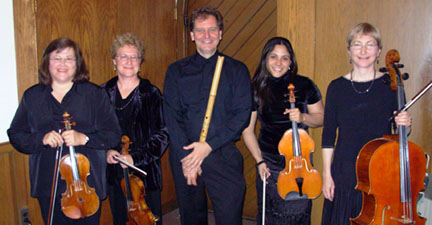
& the Satori Chamber Ensemble at the premiere of QUINTET
in May, 2006.
BIG PIECE For
Shakuhachi Orchestra (15 players) or Quintet
Big
Piece had its premiere at the BIG APPLE SHAKUHACHI FESTIVAL
(NYC) in 2004. It is meant to be played by a large group of shakuhachi
players, with several players
on each part. It can also be played by five players with one person to
a part. Parts 1-4 use 1.8' and part 5 uses 2.4' shakuhachi.
Western
5-Line Staff notation. Parts in Western 5-Line Staff or Kinko-ryu
notation.
9 minutes,
15 page score, includes separate parts for each instrument.
JS-12 - Comes with
a CD recordingof the piece (MIDI FILE).
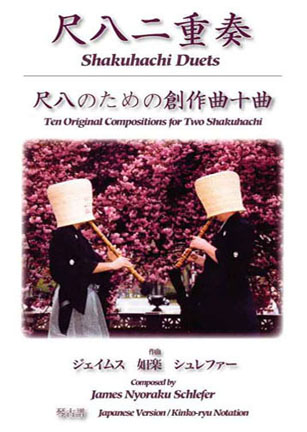
This
is a dual-language edition with text in English and Japanese and
the musical
scores
transcribed in both Kinko-ryu and
Western 5-Line Staff notation. The accompanying practice CD includes
each piece with both parts performed together as well as each part
separately.
This enables you to play along "Karaoke" style
while following the written notation provided. Since the duets
are transcribed
in Western 5-line staff as well as Japanese cursive notation, they
can be played along with silver flute, violin, guitar or any other
instrument.
Western
5-Line Staff and Kinko-ryu notation.
64 pages.
Can also be played on Western silver flute.
JS-1 - Comes with a CD recording of each piece & parts performed by
James Nyoraku Schlefer.
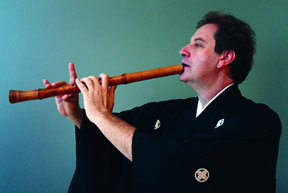
James Nyoraku Schlefer is a leading performer and teacher of shakuhachi in New York City. He received the Dai-Shi-Han or Grand Master's Certificate in 2001, and in 2007, he received a second shi-han license, this one from Yoshio
Kurahashi and the Mujuan Dojo in Kyoto. In Japan he has worked with Aoki Reibo, Yokoyama Katsuya, Yoshinobu Taniguchi, and Mitsuhashi Kifu. His primary teacher in New York was Ronnie Nyogetsu Seldin. Schlefer holds a Master's degree in Western flute & musicology from Queens College (CUNY) and currently teaches music history courses at the City University of New York. He has four solo recordings, Wind Heart (which traveled 120,000,000 miles aboard the Space Station MIR) Solstice Spirit (1998,) Flare Up (2002,) and In The Moment (2008.) His music has been featured on NPR's All Things Considered.
Nyoraku is a member of the Japanese music group Ensemble East, which performs traditional and modern chamber music for Japanese instruments, including the shamisen and the koto. He is currently the curator of Japanese music programming for Arts at Tenri, a monthly chamber music series in New York City.
Schlefer began his musical career as a Western flutist. For the past several years he has turned his attention to creating new music and to date has written numerous pieces for shakuhachi in combination with both Japanese and Western instruments. A dedicated and respected teacher, Nyoraku Sensei is head of the Kyo-Shin-An teaching studio in New York City. He has edited books of traditional notation and written and published two etude books for shakuhachi technical development.
Concerto for Shakuhachi, Strings, Harp and Percussion - First Movement "Hazy Awareness".
Written and Performed by James Nyoraku Schlefer and the SONOS Chamber Orchestra, Erik E. Ochsner, Music Director. LIVE performance - Merkin Concert Hall, NYC, May 13, 2009.